
About
What this journal is, who writes it, and where it stands
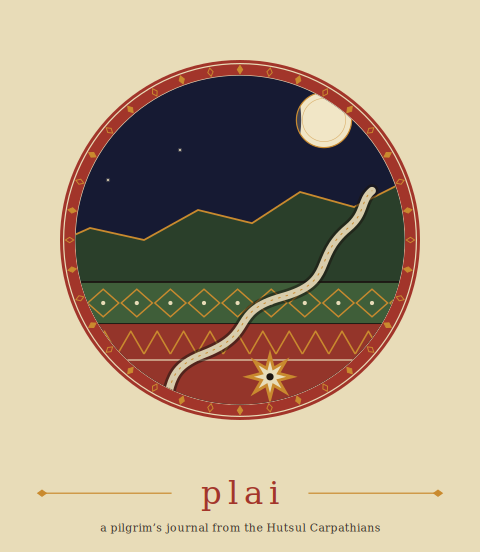
Plai is the Hutsul word for a mountain path — the track that runs along a ridge, or up to the high pasture. This journal takes the word as its name and its address.
What This Is
A pilgrim's journal from the Hutsul Carpathians. Bounded and numbered: Day 1 to Day 366, solstice to solstice, June 21, 2026 to June 21, 2027. The days are walked, and then they are written. What is here is testimony — the body reporting from the ground — not commentary on it. The ground reports too. The moon over the ridge, the feast the bell is ringing for, the cold that comes down the slope at night, the warm breath that meets a walker at one bend of the path and is gone fifty metres on. These are written as they are met. They are not explained.
The year has a hinge at Pokrova, when the high pastures empty and the valley closes in for winter. Its chambers run feast to feast, the way the year was counted here before there were weeks. Those chambers are being derived from the ground as it is lived, not laid over it in advance; the architecture will show itself in the writing before it is ever named.
Morning posts open with a number — Wake-up feel — on a scale of one to ten. The number carries what it carries. The prose does not explain it.
Who Writes It
Michel Garand. Canadian, thirty-one years in Germany, now living and working in Verkhovyna in the Ukrainian Carpathians, hosted since Ivan Kupala, 2026, at a community that works the land and holds a school in the forest.
This journal is the successor to an earlier one, kept on the Baltic coast in the spring of 2026 over eighty-four days. That one closed. This one arrived. The form carried over — the numbered days, the morning number, the bounded container — and everything inside the form is being re-derived from this ground.
Where It Stands
The ground is Verkhovyna, the heart of Hutsul land: a valley in the highlands where the Cheremosh runs young, the polonyna above it. A deep ground — herders and their vocabulary, opryshky legend in the rock, the Hasidic towns at the foot of the hills, Habsburg Galicia, the intelligentsia of Kryvorivnia, the violences of the last century, and the present war, which is here as processions and absences.
The ground keeps its own count. The year here is still turned by the moon and by the feasts, in two calendars that do not agree on the date and both of which are kept. The dead are fed on Spas. The herbs are blessed at the Dormition. The fire on the polonyna is lit at one feast and put out at another, and between them the sheep are counted by the moon. None of this is behind glass. It is what the neighbours do, and what the walker walks through.
The same moon has stood over the same ridge for the painted pots on the plain below and the mounds of the first herders and the shepherds who named the high pasture. Whatever else is here is met on the path, in the body, and written down as met — a warm wind where there should be cold, a bell at an hour no clock explains, a stone that is warm in the hand. The journal does not say what these are. It says they were there.
The place is held at the level of the valley, not the doorstep. Hosts and household are not named on any page. The children of the forest school are never named or shown. Soldiers, their families, and anything connected to their movement are not identified. These are rules, and in wartime they are not negotiable.
What It Is Not
Not a wellness product. Not a war blog. Not a self-help manual. Not a plea.
The war has a public face, and this journal is not where it is written. A companion dispatch, Soil and Peace — Carpathian Dispatch 2026, holds that register. Here the war enters only as it is lived in the body on the ground — never as report.
Three Languages
The journal is written in English, then carried into German and Ukrainian. The Ukrainian is read by a native speaker from the valley before it is published, and the readership corrects what it finds. Corrections return as new versions. Where the three languages differ, the English is the source.
Sources and Licence
The journal draws on many sources — the ethnographers who recorded this ground, the church calendars in both styles, the almanacs, the people of the valley. Each is an authority from its own perspective. None is the gatekeeper of the text. The editing decisions are the author's.
Everything here is published under Creative Commons Attribution-ShareAlike 4.0. Take it, share it, build on it, under the same terms, with the name attached.
A Pilgrim's Journey — a pilgrim's journal from the Hutsul Carpathians
Verkhovyna, Carpathian Mountains, Ukraine
© 2026 Michel Garand | CC BY-SA 4.0
stewardship@ubec.network